Data-as-a-Service

Unlock the power of your data to drive forward your competitive advantage
Nebuli data services help teams untrap their data from multiple sources or silos, combining them into complete and accurate datasets for sophisticated data analysis and digital experiences.
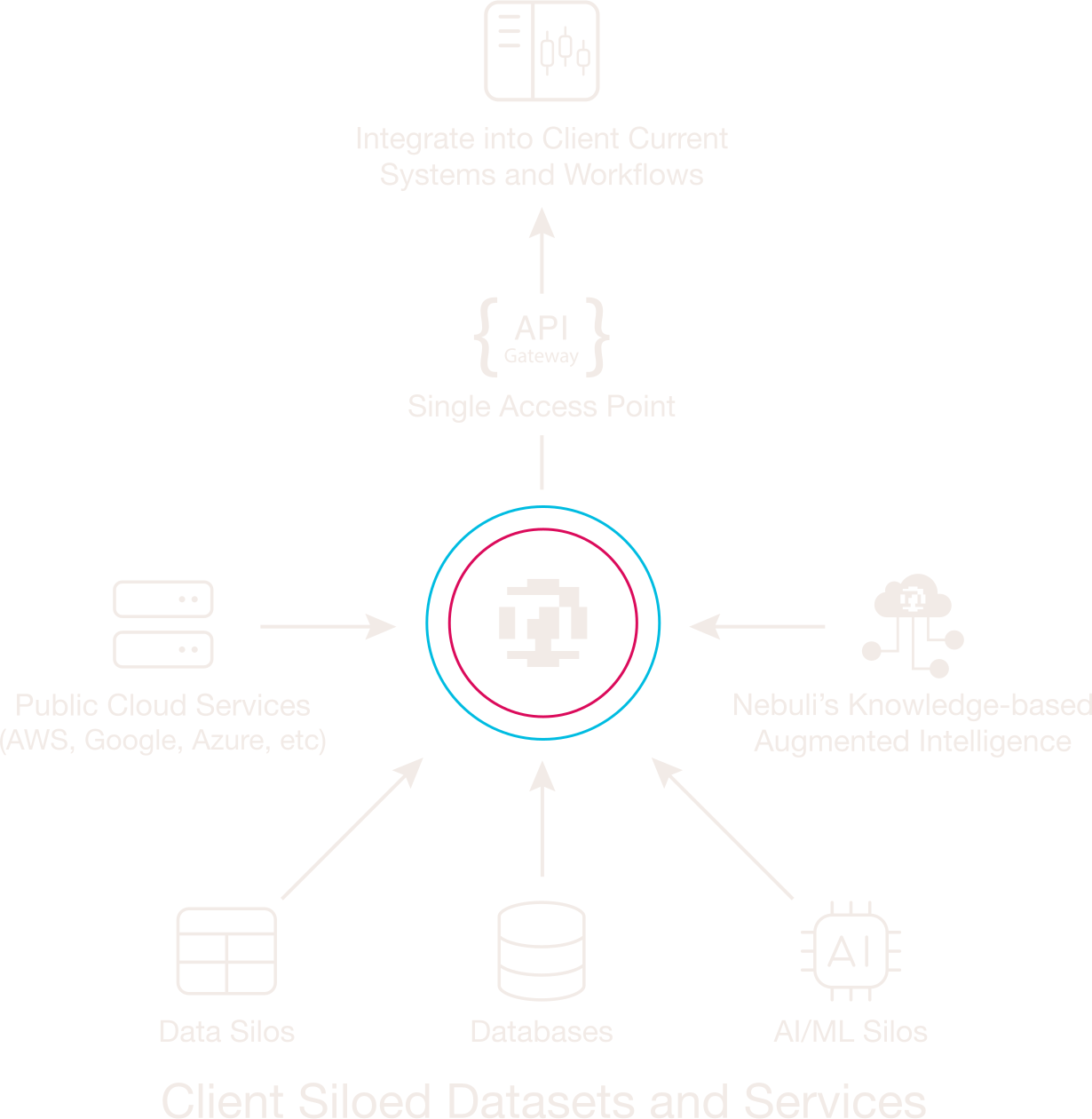
We help customers employ our Datastack framework to integrate the traditionally separate business-critical data services, such as data security, compression, modelling, classification, segmentation, knowledge discovery and much more into a single intelligence stack.

Our Datastack framework operation is independent of any data formats, platforms and languages, delivering better accessibility and faster cross-disciplinary and cross-regional data integrations and interoperability.
Open up unlimited possibilities for your team to turn your data silos into actionable results
Data Migration
Strategic data preprocessing and migration from legacy database models and file archives to integrable cloud databases.
Data Readiness & Strategies
Data catalogue assessment for achieving successful digital transformation strategies.
Hybrid Cloud Integration
Offering efficient hybrid cloud integrations, combining your on-premises servers or private cloud with public cloud services.
Data Security
Enhancing data security protocols and data privacy policies through our Nebulized Data Layer.
Data Ethics
Examining data, privacy and technological commitment toward ethical and trustworthy alignment with personal and cultural concerns.
Policy Audit & Governance
Aligning regulatory and internal policies with the fast-moving digital transformation and AI-driven world.
Prioritising Data Quality & Relevant Information Sources
Our mission is to help teams and organisations establish new data standards that uncover new business opportunities and hidden augmented intelligence capabilities through their trapped data.
We help you explore your data pain points and work with you in defining your ultimate data-driven outcomes by producing the right metrics and conditions for your end-users.
Prioritising Data Ethics & Explainable AI Models
We apply a Data-Centric AI approach – building AI systems responsibly using quality data. We ensure that the datasets involved clearly convey what the targeted AI model must learn and deliver trustworthy results.
Our approach also enforces strong data ethics and user privacy throughout the process, from planning to delivery.
Training Machine-learning Models without Anyone Seeing or Touching Your Original Data
Our data scientists map out your existing data workflows and datasets to identify trends and propose areas where automation, analytics and AI can add significant value.
Through our Datastack and Deep Vertical Understanding Embeddings (DeepVUE), we combine multiple AI services powered by contextual intelligence, vertical understanding, responsible AI models, federated learning, Human-in-the-loop AI, and AIQ cited language models to advance human-machine interactions.
Data Security with NDL
Security and data privacy are the most critical elements of Nebuli’s entire ecosystem and are at the heart of the Datastack framework
The Nebulized Data Layer ® (NDL) is Nebuli’s innovative data security layer that completely circumvents the need for customers to upload copies of their original data.
The NDL forms the central part of the Datastack and contains a customer’s indexed data needed for specific tasks. The system then compresses this indexed dataset into its internally generated semantic and ontological models that allow it to read data in any format, language and from any vertical.
The NDL Process:
-
1.
Customer dataset pre-processing:
creating data description maps to allow Nebuli algorithms “understand” the datasets. -
2.
Data extraction:
indexing the critical data parameters needed by Nebuli for a given task without storing the rest of the data. -
3.
Data Decomposition:
breaking down the indexed datasets into smaller tasks that can be parallelised within Nebuli’s operations. -
4.
Further Extraction of “useful” data parameters:
where Nebuli selects subsets of data indices to built its “Data-Driven World”. -
5.
Final normalisation of the extracted data:
to reduce data redundancy and improve data integrity, while forming Nebuli’s internal representation of the customer’s data.